Seal your crawl space for good — cleaner air upstairs, lower power bills, and a foundation protected from South Carolina humidity. Backed by a lifetime transferable warranty.
The Midlands are one of the most punishing climates in America for a vented crawl space. From April through October, Columbia's outdoor air regularly carries dew points in the 70s. Every hour, that thick, wet air pours through your foundation vents, hits the cooler surfaces under your house, and condenses — soaking your floor joists, insulation, and ductwork the way a cold glass of sweet tea sweats on a porch rail.
The old theory was that vents let a crawl space "breathe." In a humid climate like ours, the opposite is true: vents feed the moisture problem. That's why so many Columbia-area homes built on vented crawl spaces develop the same symptoms:
A musty smell that's worse in summer and never quite leaves
Cupping or squeaking hardwood floors
Mold blooming on joists and subfloor
Sagging, waterlogged fiberglass insulation
Rusting ducts and higher summer power bills
Camel crickets, spiders, and pests that thrive in damp darkness
Encapsulation solves the problem at its source. Instead of letting outside air dictate conditions under your home, we seal the crawl space off from the ground and the outdoors entirely — and put you in control of the air your family actually breathes. A large share of the air on your first floor rises up from the crawl space through gaps, ducts, and floor penetrations (the "stack effect"). Seal the crawl space, and you clean up the air supply for the whole house.
What's included
What full encapsulation includes
Every home is different, which is why we start with a free, no-pressure inspection — but a complete Vapor-X encapsulation typically involves:
01
Cleanout and prep
We remove old, failed insulation, fallen debris, and any contaminated materials so we're sealing a clean space, not trapping problems inside. If we find standing water, mold, or wood rot, we address the cause first — never just cover it up.
02
Heavy-duty vapor barrier, sealed at every seam
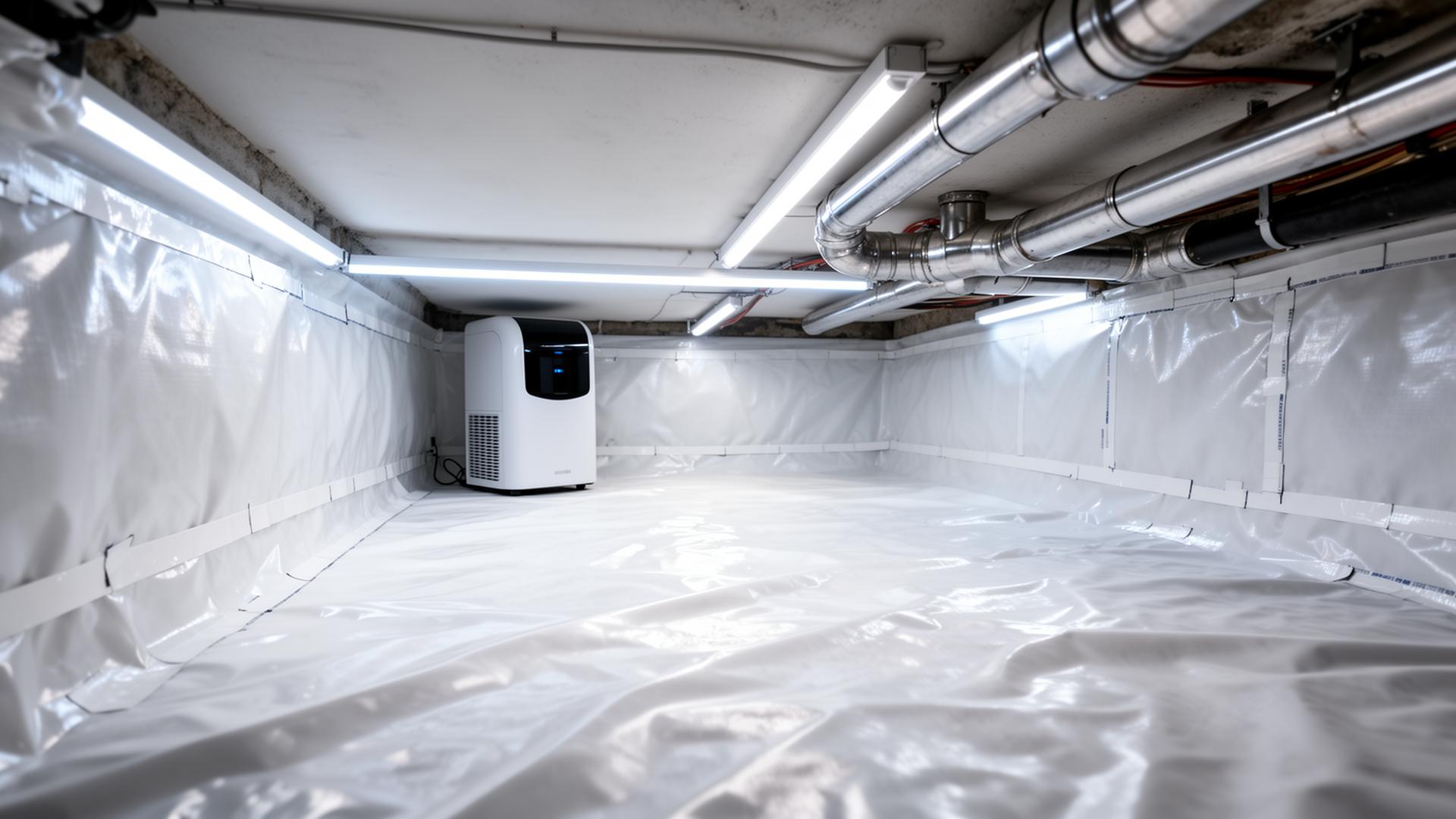
A reinforced liner is fitted across the entire floor and up the foundation walls, mechanically fastened and sealed at seams, piers, and penetrations. This is the difference between true encapsulation and the loose plastic sheets you'll see from budget installers — an unsealed barrier is just a tarp.
03
Sealing vents and outside air leaks
Foundation vents and gaps are closed off so humid outdoor air can no longer pour in.
04
Moisture management
Depending on your home, that can mean a properly sized dehumidifier, drainage, or a sump pump system — whatever it takes to keep the space dry year-round, not just dry on the day we leave.
The payoff
What encapsulation does for your home (and wallet)
Healthier indoor air
Less humidity, and no more mold spores and musty odors migrating upstairs into the rooms where your family lives.
Lower energy bills
Your HVAC stops fighting a swamp under the house; sealed, conditioned crawl spaces reduce the load on cooling and heating.
Protects your biggest investment
Moisture is what rots floor systems, corrodes ducts, and invites termites. A sealed crawl space stops the decay cycle.
Pest resistance
Dry, sealed spaces are hostile territory for the bugs and rodents that love vented crawl spaces.
Resale value
An encapsulated crawl space with a lifetime transferable warranty is a genuine selling point when you list your home — buyers (and their inspectors) notice.
A space you can actually use
The result is a bright, clean, sealed space you could crawl through in your Sunday clothes — customers tell us it ends up cleaner than their garage.
Honest answer
Encapsulation vs. a basic vapor barrier — what's the difference?
A vapor barrier alone covers the dirt floor and blocks ground moisture from evaporating into the space. It's a meaningful first line of defense, and for some homes it's the right call. Encapsulation goes further: the liner extends up the walls, every seam and penetration is sealed, vents are closed, and humidity is actively controlled.
If your crawl space problems come only from the ground, a barrier may be enough. If they come from Columbia's air — and in most homes we inspect, they do — encapsulation is the complete fix. Not sure which you need? That's exactly what the free inspection answers, and if the cheaper option is the right option, that's what we'll recommend. No used-car-salesman routine — it's how we've earned a 5.0-star rating from roughly 90 of your neighbors in Columbia, Lexington, Irmo, Blythewood, and Elgin.
Serving Columbia & the Midlands
Proudly serving Columbia, Lexington, Irmo, Blythewood, Elgin, Chapin and surrounding communities across Richland, Lexington, Fairfield and Kershaw counties.
FAQ
Frequently asked questions
Still have a question? Call (803) 653-0036 — we're glad to help.
It depends on the size of your crawl space, its current condition, and what moisture management it needs — a small, dry space needing only sealing costs far less than a large space needing cleanout, drainage, and dehumidification. That's why we quote from an in-person inspection, free and with zero obligation. Most homeowners get a firm number on the spot.
Most full encapsulations take 2–3 days. A standalone vapor barrier installation can often be completed in a single day.
Sealing the crawl space removes a major source of humid air infiltration, which reduces the load on your air conditioning in our long cooling season. Many customers report noticeable drops in summer bills — and their HVAC systems last longer because they're not fighting moisture.
Often, yes — a sealed space still needs its humidity managed, and a crawl space dehumidifier is the usual tool. Your inspection will tell us whether your home needs one and what size is right.
Frequently, yes. Crawl space moisture problems surface in home inspections and derail sales; a sealed, warrantied crawl space does the opposite. Our warranty transfers to the new owner, which is a real selling point.